2021–Present: Lunar Return, New Stations and Deep-Space Science
James Webb Space Telescope
Flagship infrared observatory for early-universe, exoplanet and solar-system science.
Era 6 of 6 · full record in the catalog
- Launch
- 25 Dec 2021
- Lead / partner
- NASA / ESA / CSA
- Target
- Sun–Earth L2
- Category
- Space observatory
- Status
- Success
- Vehicle
- unknown
- Mass
- unknown
- Orbit / trajectory
- Sun–Earth L2 orbit
Why it happened
By the mid-1990s, Hubble's deep fields had shown that long exposures on an empty patch of sky filled with galaxies and raised the question of what an instrument tuned to infrared would see, since the light of the earliest galaxies has been stretched out of the visible band by cosmic expansion. NASA's 1996 decadal planning embraced a next-generation space telescope with a mirror far larger than Hubble's 2.4 m, which meant one thing: it had to fold to fit inside a rocket fairing.
The mission
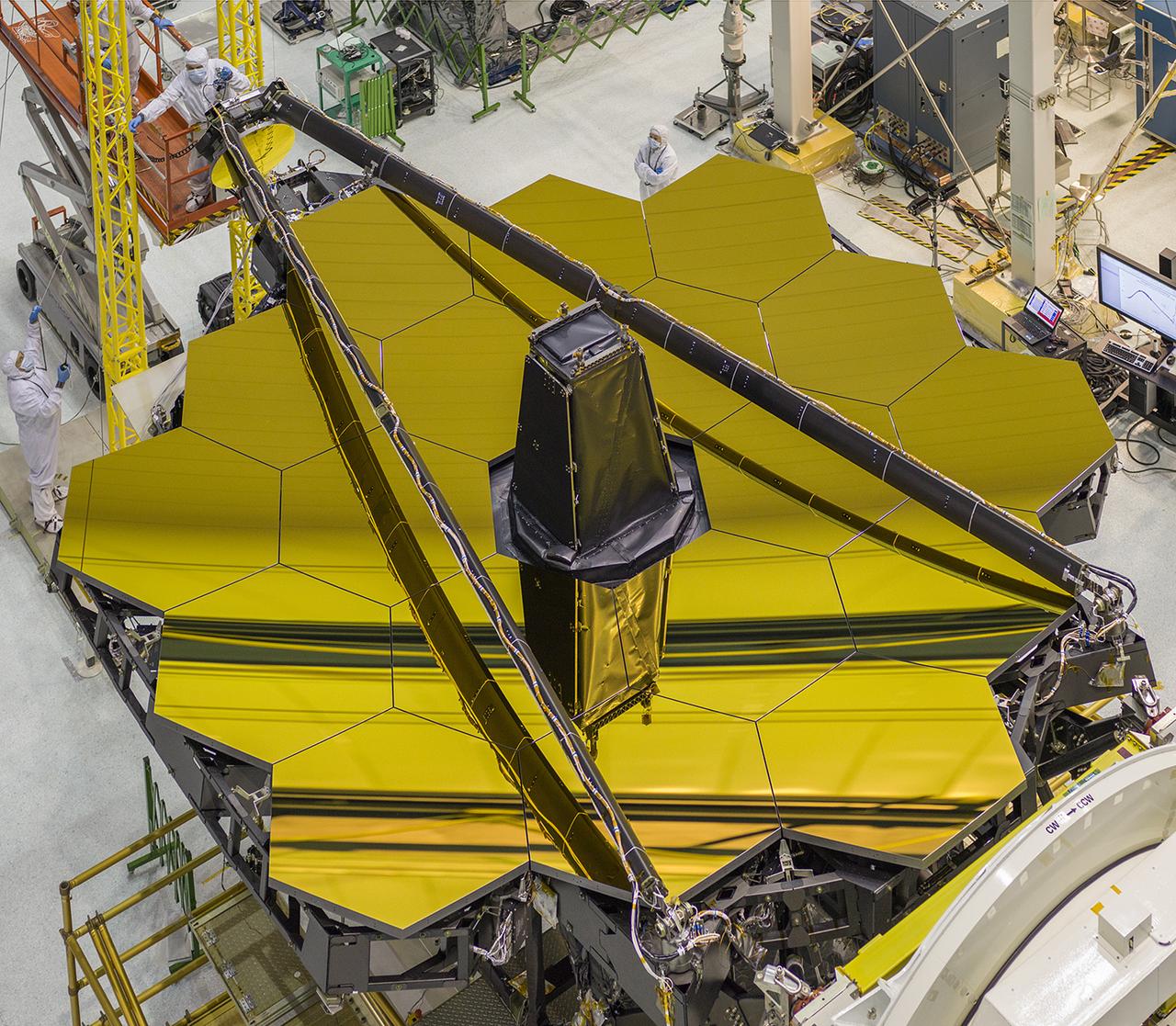
JWST launched on 25 December 2021 on an Ariane 5 from Kourou, French Guiana. Over the following two weeks it executed the most complex deployment ever attempted by a spacecraft: sunshield pallets lowered, five kapton membrane layers tensioned apart, the deployable tower extended, then eighteen hexagonal beryllium mirror segments unfolded and aligned to nanometer precision. All 344 single-point-of-failure deployments worked.
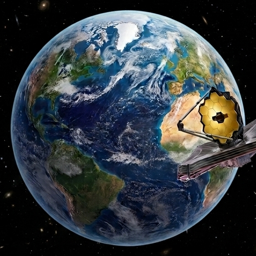
The telescope settled into a halo orbit around Sun–Earth L2, 1.5 million km from Earth, where its sunshield keeps the mirrors below 50 Kelvin. First science images were released on 12 July 2022.
Results
Flagship infrared observatory for early-universe, exoplanet and solar-system science.
Related missions
Sources & image credits
- Image credit: NASA · license: public-domain (source, checked 2026-08-22)
- Mission record: AntarikshPedia canonical dataset (data-sources/missions_timeline.md)
- Specifications reference: NASA NSSDCA Master Catalog