1957–1969: Opening the Space Age
Apollo 11
First humans landed on the Moon.
Era 1 of 6 · full record in the catalog
- Launch
- 16 Jul 1969
- Lead / partner
- United States
- Target
- Moon
- Category
- Crewed lunar landing
- Status
- Success
- Vehicle
- Saturn V SA-505
- Mass
- unknown
- Orbit / trajectory
- Selenocentric orbit
- Duration
- 8 days, 3 minutes, 23 seconds
Why it happened
President Kennedy set the target in a speech on 25 May 1961, forty days after Yuri Gagarin became the first human in orbit: land a man on the Moon and return him safely before the decade was out. The commitment was made against the backdrop of the Cold War, where space achievements read as proof of technological and, by extension, ideological superiority. NASA's budget peaked at over four percent of the federal budget in the mid-1960s to make it happen.
The mission
Apollo 11 launched on 16 July 1969 on a Saturn V from Kennedy Space Center. After one and a half orbits of Earth, the third stage reignited to send the spacecraft toward the Moon. Columbia, the command module piloted by Michael Collins, stayed in lunar orbit while Eagle, the lunar module carrying Neil Armstrong and Buzz Aldrin, descended on 20 July.
Armstrong took manual control during the final approach to fly past a boulder field with about 30 seconds of landing fuel margin. At 20:17 UTC, Eagle landed in the Sea of Tranquility. Six and a half hours later, Armstrong stepped onto the surface, followed by Aldrin. They spent 21.5 hours on the Moon, deployed experiments, and collected 21.5 kg of samples before rendezvousing with Collins and returning to Earth on 24 July, splashing down in the Pacific.
Results
First humans landed on the Moon.
Related missions
Sources & image credits
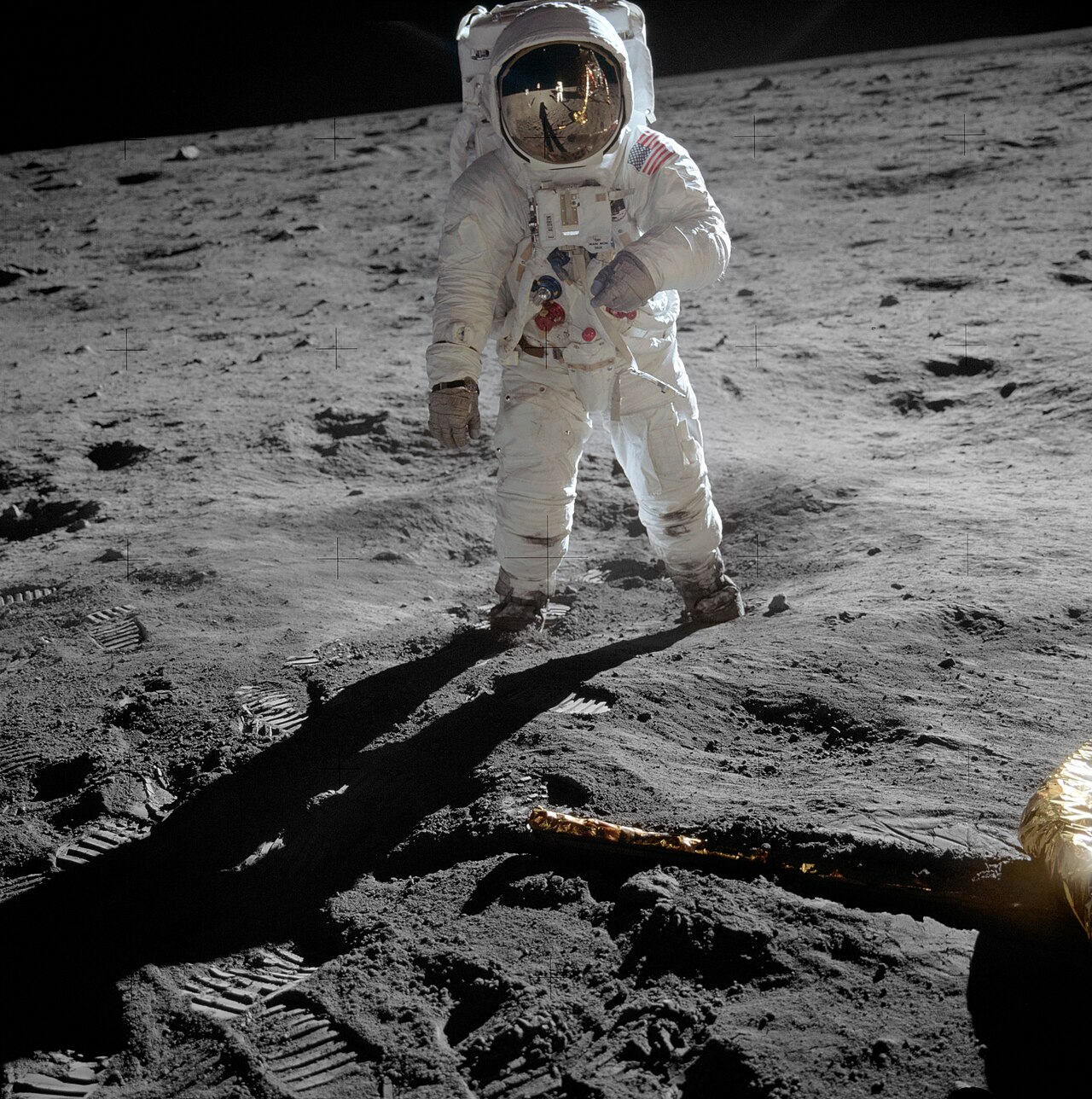
- Image credit: NASA (AS11-40-5903) · license: public-domain (source, checked 2026-08-22)
- Mission record: AntarikshPedia canonical dataset (data-sources/missions_timeline.md)
- Specifications reference: NASA NSSDCA Master Catalog
